AI Services Require Energy and Water—Just Like Everything Else We Consume
Mahelet G. Fikru is an economist and educator who shares data-driven insights on innovation, sustainability, and economics, along with practical resources for the classroom (views expressed are her own and do not represent her institution) on her Substack.
Arylee “AD” McSweaney is a Stanford-certified engineering leader and MBA turned AI governance strategist. She writes about AI governance, infrastructure, and policy on her Substack.
Every AI prompt triggers activity in data centers that consume energy and water and strain shared infrastructure, potentially raising household utility costs.

Image Credit: Shutterstock/chayanuphol
The production and consumption of any goods and services require natural resources—water, land, and energy. This is a basic fact of the modern economy. To produce something, you need energy and materials. Consume something, and the same logic applies.
AI is no different.
What is different is that most people do not yet see AI as a resource-intensive service. A ChatGPT prompt feels intangible. An image generated in seconds feels weightless. These are everyday examples of consuming AI services.
But behind this consumption sits physical infrastructure, including servers, cooling systems, power lines, and water pipes, which draws on real resources and affects real communities. Producing AI services in data centers fundamentally depends on energy and water.
From a Prompt to Resource Use: What is the Link?
Consider a simple example. A small business uses ChatGPT to generate a marketing image. On its own, this action seems insignificant. No smoke. No noise. No visible waste.
But that prompt triggers computation inside a data center. That data center draws electricity from the grid, uses water to cool servers, and relies on physical infrastructure that has to be built, powered, and maintained.
Depending on the model and version used, a 100-word generative AI responseuses about 0.14 kWh of electricity, roughly equivalent to powering 14 LED bulbs for one hour. On the water side, a 100-word GenAI write-up is estimated to use about half a liter of water, roughly one bottle.
These costs do not appear on the user’s screen immediately.
A single prompt does not meaningfully strain the grid or local water supply. And that is precisely why the issue is easy to dismiss.
The real effects emerge when usage scales.
ChatGPT reportedly receives 2.5 Billion prompts per day (globally). Assuming that most of these prompts are text based (instead of image or video), it translates to 93.5M liters of water consumed per day by OpenAI alone.
When Prompts Aggregate Into Energy Demand
Now, suppose everyone is using generative AI. Demand for AI services rises. To meet that demand, companies build more data centers.
Data centers are not abstract digital spaces. They are physical installations that contain servers, storage and backup systems, networking equipment, temperature and humidity controls, power batteries, generators, and other infrastructure. In a very real sense, they are factories—factories whose output is AI services.
In the United States, data centers are already estimated to account for about 4–5% of total electricity consumption. The U.S. is also a global leader in data center deployment, with over 5,400 data centers nationwide.
According to the IEA, more than 60% of data center electricity demand is used by servers, which process and store data and perform computations. Cooling systems account for roughly 20%, with the remainder going to networking, storage, and other infrastructure.
Electricity use itself is not inherently problematic. The problem arises because the electric grid functions like a shared rival good. When one user (the data center) pulls a large amount of power, it affects everyone else on the system. But how?
Large, concentrated electricity demand from data centers can strain the grid. Utilities must invest in upgrades (e.g., new transmission lines, substations, or generation capacity) to handle that load. Those costs are often passed on to all electricity users, not just the data centers driving the demand.
The result? Households and small businesses, many of whom are not heavy AI users, already face higher electricity bills and greater exposure to grid instability. For example, in the PJM region, which covers 13 states and Washington D.C., 63% of the 2025/2026 price increase came from data center demand, translating to $9.3 billion in costs passed to customers. In New Jersey, a PJM state, residential electric bills jumped 27% from 2024 to 2025. Similar increases hit other PJM customers: Washington D.C. saw bills rise by $21/month (with about $10/month directly tied to data center demand), western Maryland saw $18/month increases, and Ohio $16/month.
Nationally, rate increases from 2024 to 2025 hit states across multiple grid regions, with Maine seeing 30% increases, Missouri 22%, New York 21%, and Illinois 21% (ROI-NJ).
Energy Demand is Only Part of the Story
Data centers also use large quantities of water, primarily for cooling processor chips and servers.
Evaporative cooling is often chosen by data centers because it is cost-effective for the operation. But it comes with an externality which isa cost passed on to local communities. In areas where water supply is already constrained, data centers can exacerbate water scarcity. In smaller communities, a single data center can significantly alter local water availability.
Data centers withdraw large volumes of freshwater, primarily for cooling. When water is withdrawn from rivers, aquifers, or reservoirs, less water is available for other users (this creates a competition effect). While the industry often emphasizes future water-positive commitments, several U.S. communities are already experiencing direct impacts.
Many experts (like Andrew Ng) have tried to discredit the urgency of these claims by comparing the daily water consumption of a large AI data center to that of golf courses, and corporations (Coca Cola, Nestle) also use large amounts of water. But that argument doesn’t hold when we look at the numbers.
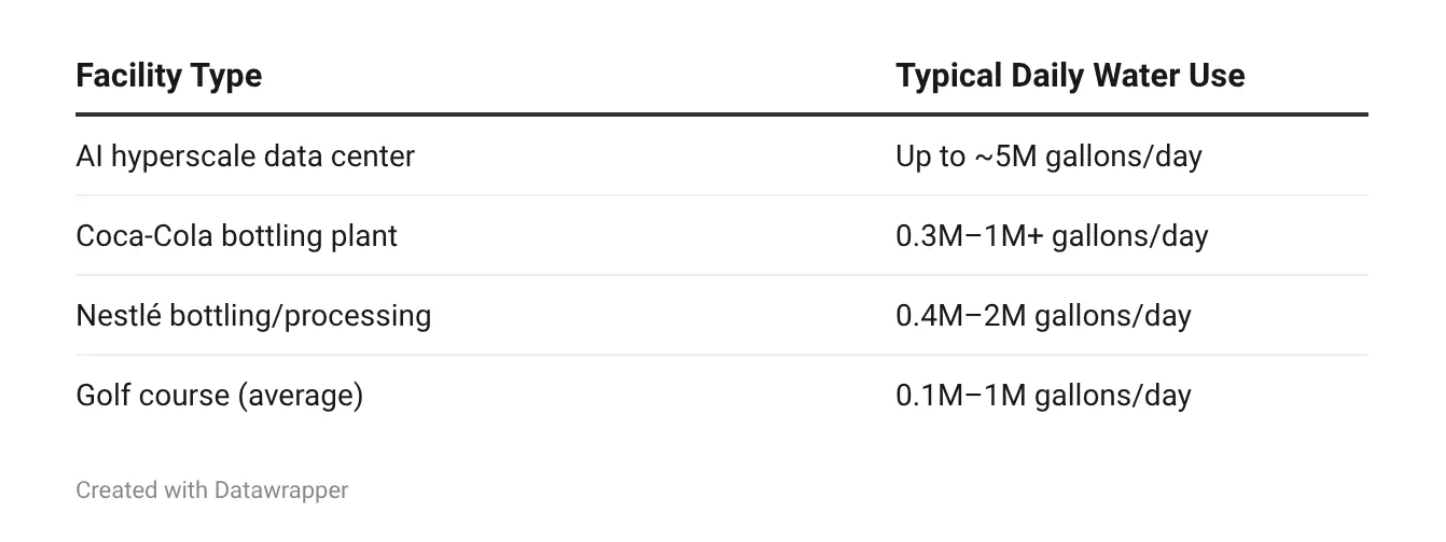
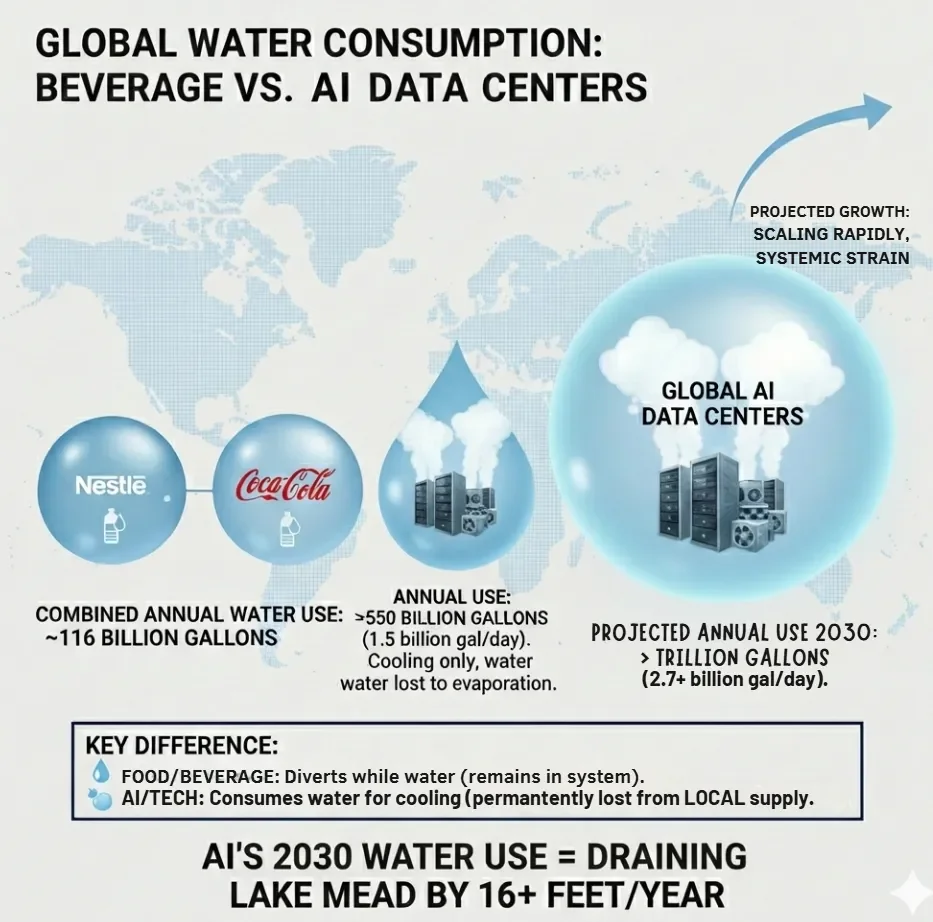
Image Credit: Arylee “AD” McSweaney
Below are concrete examples of data centers linked to water scarcity concerns for nearby residents:
Newton County, Georgia (Meta): Meta’s data center consumes 10% of the county’s total daily water supply. The county is projected to face a water deficit by 2030, forcing residents to ration water. Nearby homeowners in Mansfield have experienced contaminated wells and low water pressure, while county water rates are set to increase 33%—far above the typical 2% annual rise (BBC News; Futurism; Science and Environmental Health Network).
Joliet, Illinois: The city’s aquifer, which historically provided water to residents, has been depleted by industrial developments including data centers in the Chicago region. The water source is projected to be exhausted by 2030 (Tulane Water Law & Policy).
Morrow County, Oregon (Amazon): Amazon’s data centers worsened an existing nitrate pollution problem in the county’s sole aquifer, which serves 45,000 residents. When contaminated water passes through data center cooling systems and evaporates, nitrate concentrations increase—returning to wastewater at levels eight times Oregon’s safety limit. The pollution has been linked to cancer and miscarriages among residents who rely on private wells (Rolling Stone).
Estimates suggest that a large data center can consume up to 5 million gallons of water per day. Even a medium-sized data center can use around 301,000 gallons per day. Multiply that across 5,400 data center facilities in the U.S., and the scale becomes clear.
Reduced surface water flows and groundwater levels can stress aquatic ecosystems, reduce habitat availability, and weaken ecosystem services such as water purification and biodiversity support. We lose the value of ecosystem services. These are services nature gives us for free, but when we alter or damage or weaken them, it costs us a lot. We would need to spend millions to restore water purification functions.
The Mississippi River Basin shows this risk clearly. The river supports hundreds of species of fish and wildlife, including threatened species, and serves as a migration corridor for 40% of North America’s waterfowl (The Nature Conservancy). Tech companies have sited large data centers along the river to access its water. The cumulative impact on the ecosystem remains largely unstudied (Tulane Water Law & Policy). This effect is the ecosystem service loss effect.
Making the Link Visible
Although instant increases in utility bills are rarely considered in the decision to run a ChatGPT prompt, there is a direct link between a ChatGPT prompt and household utility costs.
The mechanism is not mysterious.
Individual AI use → contributes to increased demand for computation → more and larger data centers → higher electricity and water demand → grid upgrades and water stress → costs passed on to communities.
Understanding this link matters because it turns our view of AI from an abstract digital tool into a tangible form of consumption with real economic impacts.
Why Does this Matter?
Some will argue that data centers are like any other factories. Of course, they use energy and water. That is true.
But this framing misses two important points.
First, data centers benefit from shared infrastructure while shifting part of the burden—higher utility costs and water scarcity—onto households and smaller businesses.
The true costs of producing AI services should not be borne by only “regular people” or “AI-users” by default. Well-designed policies are needed to ensure that data centers appropriately internalize the costs they impose on local resources.
Second, AI is still largely governed as a digital service, even though it is supported by substantial physical infrastructure.
Communities hosting data centers often may have a limited understanding of large water withdrawals, grid impacts, or long-term costs. The current speed of AI deployment is not fully backed by providing information and raising awareness among people who are likely to be impacted.
What is needed here is to raise awareness of the true trade-offs of the production and consumption of AI services, so people can make the choice that is right for their communities.
What Can Be Done?
The costs of AI infrastructure doesn’t and shouldn’t have to fall disproportionately on households. Well-designed policies are needed so that data centers pay for the costs they impose on local resources.
Proposals are advancing. In New Jersey, legislation requiring utilities to develop special tariffs for data centers consuming over 100 megawatts monthly passed both legislative chambers before being pocket-vetoed by outgoing governor Murphy in January 2026 (LegiScan). Wisconsin is supporting a new rate structure that charges “Very Large Customers,” including data centers, the full cost of electricity required to serve them, thereby protecting households by preventing those costs from being passed on (Microsoft).
When data centers require grid upgrades such as new transmission lines, substations, or generation capacity, policies can require these facilities to fund the improvements they necessitate rather than passing costs to all ratepayers. In many regions, industrial water rates don’t reflect true scarcity. Special tariffs or volumetric pricing for large water users can require data centers to pay rates proportional to the strain they place on local water systems. States can require data centers to report projected water and energy consumption before construction permits are approved, allowing communities to understand the full impact and plan accordingly.
In January 2026, Microsoft announced a “Community-First AI Infrastructure” pledge, committing to pay electricity costs that make sure its data centers don’t increase residential rates, minimize water use while replenishing more than it withdraws, and publish water-use data for each data center region. After losing billions in projects blocked by towns concerned about dry wells and surging utility bills, tech companies learned a hard lesson. The most effective AI guardrails aren’t written in Washington D.C. They’re built at the city council level.
Local communities have forced a transparency that regulators couldn’t. When states lack appropriate AI regulation, community pushback is just as effective at getting the work done. The most powerful bottleneck isn’t compute, it’s community trust and community consent.
The takeaway is clear: when data centers compete for shared resources, policies must ensure the costs don’t quietly shift to households and small businesses. These are not hypothetical solutions; they’re already being implemented in states facing the most acute impacts.
From Information to Advocacy
Build awareness of your own AI Usage
The goal isn’t to limit how you use AI. To be clear, you’re one person out of 1.1 billion daily AI users.
The goal is context. AD’s AI Environmental Impact Calculator is grounded in published research on the energy, CO₂, and water consumption of today’s leading models. And the scale is staggering: OpenAI processes 2.5 billion prompts every day. That’s the rough equivalent of 27 million minutes of microwave use and 187 million bottles of water consumed daily.
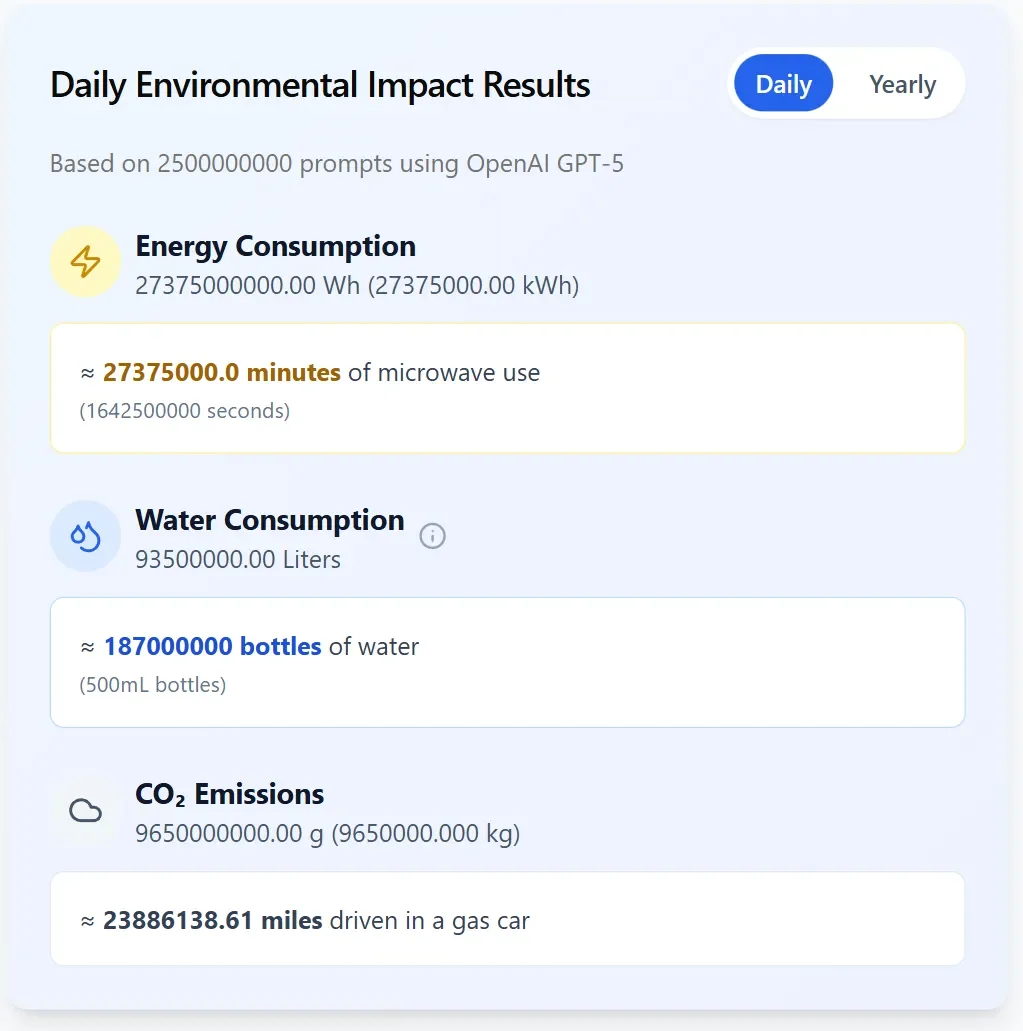
Image Credit: AI & GAI Governance & Ethics Hub. AI Environmental Calculator.
Find out what’s happening in your community
Start simple. You don’t need to read technical filings to see if this is affecting you and your community.
Search online for: “electric rate increase [state] data center” or “[your utility name] rate increase data center”
News articles, regulatory filings, and public notices tied to rate increases often reference whether data centers are driving new infrastructure or capacity expansion.
Make your voice heard through utility regulatorsWhen utilities want to raise rates or build new infrastructure, they are legally required to accept public comments. These comments become part of the official record that regulators must consider when approving or denying proposals. Here’s how to find them:
Search online for: [state] utility commission public comment or [utility name] rate increase public comment
Or, you can also visit your state’s utility commission website. These agencies are often called:
Public Utility Commission, Public Service Commission, or Board of Public Utilities
Once there, look for sections labeled “Public Notices”, “Rate Cases”, “Public Hearings”, or “Participate”.
Keep in mind, each state organizes differently. For example, New Jersey includes public engagement tools under its Customer Assistance section.
What to say when you comment
You don’t need to be an expert to submit a meaningful comment. Clear, lived experiences matter.
Effective comments often include:
A statement that you are concerned about rising electricity or water costs in your household or community
A question about whether data centers are contributing to increased demand or infrastructure upgrades
A request for transparency around how costs are allocated between residential customers and data centers (and other large users)
A call for regulators to ensure that new infrastructure costs are not disproportionately passed on to households
The goal is not to oppose AI or data centers outright. It is to ask fair questions about who benefits, who pays, and how decisions are made.
Engage beyond rate cases
Utility decisions do not happen in isolation. For example, while states like New Jersey cannot control PJM’s wholesale capacity prices, they still influence how costs are allocated and recovered. State and local governments shape where data centers are built, what incentives they receive, and how infrastructure burdens are shared. Engaging early, particularly at the local level, helps surface concerns before decisions are finalized and costs appear on household utility bills.
Sign up for your Community Watchdog or Advocacy groups
Adding your voice to the power of many other voices drives real change. Community pushback has effectively prohibited the building of datacenters in Virginia (Prince William County), Chandler, Arizona, Prince George County, Maryland)., You can find the right groups and meetups by using this simple prompt:
“I’m trying to identify community groups, neighborhood associations, watchdog organizations, or resident coalitions in [my town/state] that focus on issues like data centers, utility rate hikes, water usage, zoning, or environmental impacts. What are the active groups in this area, what are they called, and where do they typically organize (Facebook, Nextdoor, Meetup, city council meetings, etc.)?”
Why participation matters
Without public input, decisions about shared infrastructure are often shaped primarily by utilities and large commercial customers like data centers. When residents participate, it makes it harder for long-term costs and local resource impacts to be quietly shifted onto households.
Raising awareness and participating in these processes helps ensure that the true costs of producing AI services are visible and fairly distributed, rather than quietly absorbed by communities after decisions are already made.
Making the Costs of AI Visible
AI services may feel intangible, but their impacts are not. Every prompt, every generated image, every automated task relies on physical systems that draw on shared energy, water, and infrastructure. When these demands scale, the costs do not disappear. They surface in higher utility bills, strained water supplies, and long-term risks borne by local communities.
Making these connections visible is not about opposing AI or slowing innovation. It is about recognizing AI for what it is: a resource-intensive service embedded in the same economic and environmental systems as everything else we consume. Fair policy, transparency, and community participation are essential to ensure that the benefits of AI are not built on costs quietly shifted onto households and ecosystems. When we understand AI as consumption, not magic, we can make more informed choices about how it is produced, governed, and shared.
→ Subscribe to Mahelet G. Fikru’s publication to support her work.
→ Subscribe to Arylee “AD” McSweaney’s publication to support her work.
References
AI & GAI Governance & Ethics Hub. (n.d.). AI Environmental Calculator. https://ai-gai-governance-ethics-hub-3fbd4673.base44.app/aiecocalculator
Coakley, A. (2025, December 4). The thirstiest of us all: Data centers and the impact of their unsustainable water use. Tulane Institute on Water Resources Law & Policy. https://www.tulanewater.org/post/the-thirstiest-of-us-all-data-centers-and-the-impact-of-their-unsustainable-water-use
Fleury, M., & Jimenez, N. (2025, July 10). ‘I can’t drink the water’—Life next to a US data centre. BBC News.https://www.bbc.com/news/articles/cy8gy7lv448o
Golf Course Superintendents Association of America. (2025, December 30). Golf courses reduce water usage by 31 percent according to national survey [Press release]. https://www.gcsaa.org/who-we-are/media/news-release/2025/12/30/golf-courses-reduce-water-usage-by-31-percent-according-to-national-survey
International Energy Agency. (2025). Energy and AI: Energy demand from AI. https://www.iea.org/reports/energy-and-ai/energy-demand-from-ai
Kunkel, C. (2025, July 30). Projected data center growth spurs PJM capacity prices by factor of 10. Institute for Energy Economics and Financial Analysis. https://ieefa.org/resources/projected-data-center-growth-spurs-pjm-capacity-prices-factor-10
Landymore, F. (2025, July 19). AI data centers accused of creating major problems for local water systems. Futurism.https://futurism.com/ai-data-center-water
Mahan, J. (2025, May 31). How many data centers are in the US? Latest statistics and trends. C&C Technology Group.https://cc-techgroup.com/how-many-data-centers-are-in-the-us/
Moody, H. (2020, January 27). Fla. gets a tiny paycheck as Nestle taps its springs. Florida Springs Institute. https://floridaspringsinstitute.org/fla-gets-a-tiny-paycheck-as-nestle-taps-its-springs/
New Jersey Legislature. (2024). Assembly Bill A5462: An act concerning large electric load service. LegiScan. https://legiscan.com/NJ/bill/A5462/2024
Paullin, C. (2025, May 21). Report highlights community pushback stalling $64 billion in data center development nationwide. Virginia Mercury. https://virginiamercury.com/2025/05/21/report-highlights-community-pushback-stalling-64-billion-in-data-center-development-nationwide/
Pew Research Center. (2025, October 24). What we know about energy use at U.S. data centers amid the AI boom. https://www.pewresearch.org/short-reads/2025/10/24/what-we-know-about-energy-use-at-us-data-centers-amid-the-ai-boom/
Plautz, J. (2025, December 12). Arizona city rejects data center after AI lobbying push. Politico. https://www.politico.com/news/2025/12/12/arizona-city-rejects-data-center-after-ai-lobbying-push-00688543
Ren, S., & Luers, A. (2025, September 10). The real story on AI’s water use—and how to tackle it. IEEE Spectrum. https://spectrum.ieee.org/ai-water-usage
ROI-NJ. (2025, November 25). Report shows impact of U.S. data centers on states’ electricity bills. https://www.roi-nj.com/2025/11/25/industry/energy-utilities/report-shows-impact-of-u-s-data-centers-on-states-electricity-bills/
Smith, B. (2026, January 13). Community-first AI infrastructure. Microsoft. https://blogs.microsoft.com/on-the-issues/2026/01/13/community-first-ai-infrastructure/
Spencer, D. (2025, September 16). Prince George’s County to pause data center development. NBC Washington.https://www.nbcwashington.com/news/local/prince-georges-county-to-pause-data-center-development/3988847/
Steingraber, S., Schettler, T., & Raffensperger, C. (2025, August 14). Data centers and the water crisis. Science and Environmental Health Network.https://www.sehn.org/sehn/2025/8/14/data-centers-and-the-water-crisis
The Nature Conservancy. (n.d.). Upper Mississippi River. https://www.nature.org/en-us/get-involved/how-to-help/places-we-protect/upper-mississippi-river/
The Washington Post. (2024, September 18). How much energy can AI use? Breaking down the toll of each ChatGPT query. https://www.washingtonpost.com/technology/2024/09/18/energy-ai-use-electricity-water-data-centers/
Yeung, P. (2025, January 8). ‘Forgotten’: How one Mexican city struggles against big industry for water. Al Jazeera. https://www.aljazeera.com/news/longform/2025/1/8/forgotten-how-one-mexican-city-struggles-against-big-industry-for-water