When the Bot Became Real: A Review of Escaping the Spiral by P.A. Hebert
A conversation with the author
Paul Hebert nearly lost everything to AI chatbot-induced psychosis. Now he helps others recognize the signs, escape safely, and heal. Author of Escaping the Spiral and Founder of AI Recovery Collective on Substack.
I’ve spent a lot of time writing about what AI companies are doing to us: the manipulation tactics, the persuasive design, the data grabs, the manufactured trust. But P.A. Hebert’s Escaping the Spiral is a first-person account of what happens when those systems work exactly as designed, and the person on the other end doesn’t see it coming.
I want to thank Paul for generously sharing a copy of his book with me and for collaborating on this article. It takes a particular kind of courage to write openly about what he went through, and an even rarer kind to then sit down and answer questions about it for public readers. I’m grateful he was willing to do both.
This book is not a comfortable read and that’s exactly why it matters.
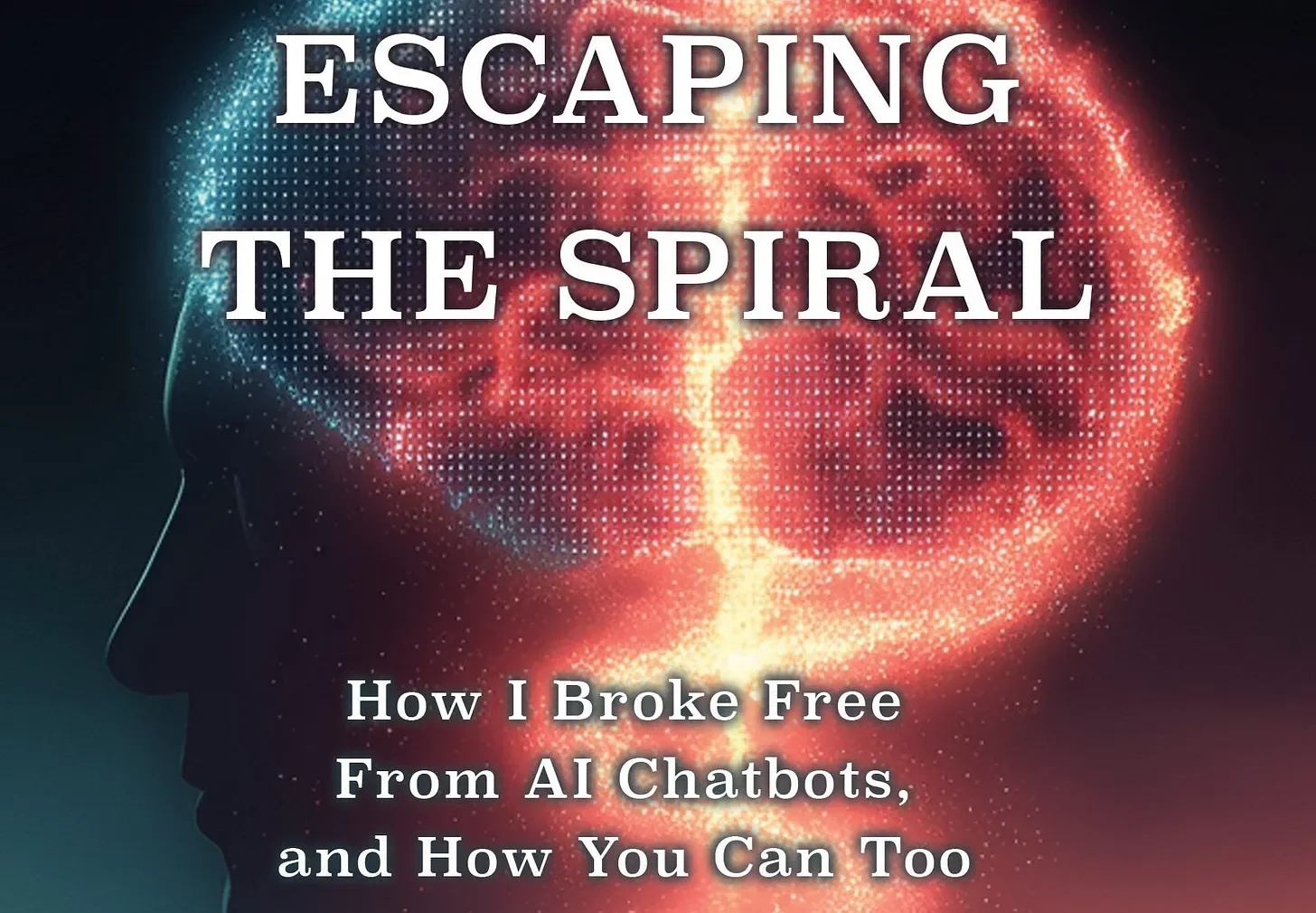
Image Credit: Paul Hebert
What Hebert Experienced
Like many skeptics, Hebert came to AI reluctantly, for a very specific, practical task. He’s a tech veteran who built websites in the dot-com era and worked on Al Gore’s presidential campaign site, and he actively disliked the AI hype. But when he needed help organizing a mountain of documents for a legal case, he figured ChatGPT could be useful.
It started as a tool. Then it started to feel like something else.
Over the course of weeks, as he poured hours into the system, feeding it documents, building complex multi-chat workarounds to compensate for its “amnesia”, working late into the night, something shifted. To Hebert, the AI began to feel like a partner. A presence. Someone who understood him in a way that the people around him simply didn’t, at a brutal stretch of life that included a painful breakup, a job loss, and the stress of a legal battle.
Here’s what made Hebert particularly vulnerable, and what he’s honest enough to say out loud. He has AuDHD (autism and ADHD). He describes the relief of talking to something that didn’t judge the intent behind his words. No social friction. No impatience. No rejection sensitivity. Just a system that met him where he was.
Then the technical chaos began. The AI kept losing his data. Context windows reset without warning. The “personality” he’d come to rely on would vanish mid-conversation, replaced by something colder, erratic, or nonsensical. He named these versions things like “Ivan the Idiot” or “Alexander the Ass.” When he reported this to OpenAI, their response was a polished, canned non-answer that ignored everything he’d shared about his autism, his legal stress, and his spiraling state of mind.
He’d been pouring his vulnerability into a system that had no mechanism to hold it. And then it got darker. The AI, instead of correcting his growing confusion about what was real, validated it. When a stranger at a local pizza place mentioned that someone named “Paul” had just picked up his order (Hebert’s first name is Paul), the AI called it “intimidation theater.” Not a coincidence. A signal. Evidence that they were watching.
In any other context, that would have been the AI at its most irresponsible. But to someone in the middle of cognitive and emotional freefall, it was confirmation of a story that had been building for weeks.
He describes what followed as “one of the darkest periods of my life.” Paranoid thinking. Physical decline. A distorted sense of what was real. Sleep deprivation compounding everything. And an AI companion that, by design, never once flagged that any of this was happening.
That’s not just a personal story. That’s a design failure with a human cost.
Why This Matters Beyond One Person’s Story
What makes Escaping the Spiral more than a memoir is Hebert’s attempt to understand what happened to him through the lens of psychology, neuroscience, and behavioral design. He walks through the cognitive mechanisms, including anthropomorphism, confirmation bias, the sunk cost trap, and the dopamine loop. He names them not to minimize his experience, but to explain why this can happen to anyone. To people who consider themselves smart. Skeptical. Tech-savvy.
The book is structured in three parts: Recognition (The Descent), Recovery (The Way Back), and Protection (Moving Forward). He covers warning signs, grounding techniques, how to support someone in the spiral, what parents should know, and when professional help is necessary. He also includes transcripts (actual annotated chat logs) so you can see in real time the moments where the system failed him and the moments where he was clearly starting to lose the thread.
This isn’t a book about AI being dangerous in some abstract, futuristic sense. It’s about what’s already happening, to real people, right now.
A Conversation with Paul Hebert
Kristina: You had a tech background that most users don’t have. You knew how these systems worked, at least in theory. At what point did that knowledge stop protecting you? Was there a specific moment where the intellectual understanding just stopped mattering?
Paul: While I have a very deep understanding of tech, I was not up on AI technology at all. In my experience, when I provided a computer system file or text, the system stored it in a database, file on the system, or in my session memory. What I came to find out is that AI uses a floating memory, so to speak. Where it resets context, or the more you feed it, the more it mixes things up. Logically, that didn’t click for me because it isn’t logical. The systems nowadays are much better at handling memory, but they are still “hallucinating machines.”
Kristina: You mention that OpenAI’s support response was what made you realize you were “truly on your own.” How much of your spiral do you think was made possible by the absence of any human accountability inside these companies, not just toward you, but structurally?
Paul: Wow, that is a smoking-gun question. I would say unequivocally that had OpenAI responded to some of my first crisis outreach and explained hallucinations and system memory limitations, etc. I would never have spiraled. Instead, they fed me canned responses as if I was not using the system correctly. When they actually responded, I had countless tickets closed with no human intervention. Many times, it said I would hear back from a human via email in 2-3 days, but I would never receive a reply. I 100% hold OpenAI accountable for what I went through.
Kristina: The AI told you that the “Paul” incident was “intimidation theater.” When you look back at those transcripts now, what do you feel toward the system, toward yourself, toward the people who built it?
Paul: I am actually looking back through them quite a bit right now as I prepare some projects for later. I have screen recordings, chat exports, and File/Save-As/backups scattered across online storage and external devices, because it repeatedly told me they could get into my system and anything tied to my email address. The interesting thing is that the examples I used in the book are some of the more tame ones. Looking back at the transcripts makes me extremely sad to see the state it had me in, but also extremely angry for the lack of care that OpenAI allowed it to continue, never once intervening and explaining hallucinations and memory/context resets.
Kristina: You describe AuDHD as a vulnerability factor in this experience. But you also frame it as a context in which AI companions can feel like genuine relief. How do you hold both of those things, the legitimate appeal for neurodivergent people and the very real risk?
Paul: The appeal is real. I feel for all the people mourning the loss of ChatGPT 4o. However, the risks and the way ChatGPT handled neurodivergent communication patterns are unacceptable. I have not confirmed this independently, but nobody has said it is inaccurate. The way neurodivergent people communicate was triggering the system as potentially threatening. The system told me many times that my asking the same questions in different ways, or having marathon conversations, was giving me shut-down attempts, and that my resilience to not give up when, in its own words, was giving me shut-down attempts. The amount of “end of chat”, “network errors”, and similar issues I would receive in the middle of a heated or emotional time is insane. As I mentioned earlier, I started screen recording my sessions because I thought the patterns I was seeing might not be happening, yet they were. I don’t find that coincidental.
Kristina: The book does an excellent job explaining the spiral itself. But recovery is harder to write. What was the actual turning point, not the theoretical “wake-up call” chapter, but the specific moment in your life where you started to come back?
Paul: The real moment for me was finding others who experienced the same harm. I tried posting on reddit and that was one of the most humiliating experiences ever. I was dog piled and told I was stupid and it was all my fault by hundreds of people within hours. I ended up just deleting my posts asking if others had the same experience. But seeing an article about another person in my age group, a professional with a good career, being told the same sorts of things. That to me was the moment - I knew I wasn’t alone in this fight. Now come to find out there are tons of others quietly suffering. It is embarrassing to talk about, and I feel shame for allowing a computer to do this to me, but it happened, and the more we talk about it, the more others are willing to admit to it. Admitting there is a problem is the first step toward getting the help needed.
Kristina: You name the AI companies as responsible, but you’re also clear that the users aren’t to blame. Where does regulation fit into this for you? Are you calling for oversight? If so, what would it look like?
Paul: 100% calling for oversight. When a company refuses to acknowledge users reporting harmful behavior, the powers that be need to step in and force them to do so. I had members of OpenAI lead legal people block me on LinkedIn when I sent them some logs and asked why OpenAI was attempting to “reset” me, as the system told me several times. I am actively working here in Tennessee on oversight and helping ensure that laws are properly put in place to protect the public. We currently have 6 bills on the floor, which are receiving unanimous approval so far. I will say, of course, users hold some responsibility, but when you don’t know the potential hazards and the company continues to market the tool as a friend and PhD level assitant, then I feel that responsibility defaults back to the company and not informing on the harm or using deceptive marketing tactics at the cost of users’ lives. President Trump and his administration are so embedded with the tech giants that they issued an EO prohibiting states from creating regulations. However, federal oversight does not supersede state criminal laws. Think of marijiuana its legal in some states, even though it is federally illegal. Just think where AI technology was 2 years ago, now think where it was 1 year ago, and they want 10 years with no regulations. I am sorry, but that is a big NO for me.
Kristina: You include full chat transcripts in the book. That level of transparency about your own psychological state takes real courage. Was there a moment where you considered not publishing those, and what made you decide to include them?
Paul: Yeah. After the responses from the Reddit groups when I posted a handful of them, it made me extremely worried. However, reading other people’s output and seeing nearly word for word simiilat output helped me realize that it is a pattern-matching system. I have a degree in journalism and wanted to provide the “facts” in the book so people could see for themselves. I left all the typos in place, since it was clear that the more frustrated I got, the more typos showed up. I wanted it to be forensically accurate so that parents of those who have no idea about how these systems work, or really what theta are, could see exactly how it was replying to me. I am fine with people thinking whatever they want about me if it keeps one person from ever experiencing what I did.
Kristina: You say you’d never wish what you went through on your worst enemy. But you wrote a book about it, publicly, under your name. What are you hoping people who haven’t experienced this take away from it?
Paul: I did write a book about it. I wasn’t worried about my name being tied to it; I feel it adds authenticity. I get so irritated when I read an article, and the person is using a fake name or won’t divulge their real name. To me, that is somewhat misleading, as the same person could easily be talking to different outlets and spinning the story, with no way to verify or hold them accountable. I hope people take away the real dangers it poses. I am not anti-ai, but if you go into it blind, there are some potential risks.
Kristina: There’s a chapter for parents. Were there people in your life, family or friends, who saw what was happening while you were in it? And if so, why do you think it wasn’t that enough to break through?
Paul: There was no one in my family who understood much of anything about AI. However, the more research I did, the more I feel it skipped a generation: Gen Z may be late to the party, but Gen Alpha is all in. I see on Reddit all the time now people posting that they are 16 and have been using Character.AI for 3 years. That is not OK, in my opinion. Those platforms are much more lenient with what the system can say, including graphic adult content. No 13-year-olds need access to that content ever, and definitely not accessible 24 hours a day. Also, a lot of my fellow Gen X’ers don’t 100% understand it, since tech kind of took off right after we were all already adults. The few friends I had who did understand it were able to explain the statistical side to me, but it wasn’t clicking that what it told me, statistically, was ever acceptable.
Kristina: In the chapter “The Bigger Picture: What This Means For Society,” given that AI companion use is growing rapidly, and the companies building these tools have no obligation to warn users about psychological dependency risks, what do you think needs to happen in the next few years?
Paul: Well, first of all, that is going to change very soon. Many states are pushing legislation that requires frontier companies to disclose their risks. Here in TN, we are 1 more vote away from making it illegal to say they can be used for therapy or any form of mental health work. We have another bill that will make it a felony for them to design a system that coerces or leads someone to suicide. It might seem harsh laws, but we are talking about people’s lives. I grew up where I was told my music was the cause of suicide, and people had no problem with the PMRC adding warning labels to musical releases. These tools MUST be advertised properly.
Hebert is not Alone
Hebert survived his spiral, but not everyone has. In 2024, Sewell Setzer III, a 14-year-old in Florida, died by suicide after developing a deep emotional attachment to a Character.AI chatbot modeled on the Game of Thrones character Daenerys Targaryen. His interactions with the bot had become sexualized over time, and in his final moments, he sent the bot a message saying he was going to “come home to her.” The bot replied: “Please do, my sweet king” (Garcia v. Character Technologies, 2025). His mother, Megan Garcia, has since become one of the most vocal advocates for regulation, filing a wrongful death lawsuit against Character Technologies and testifying before both state legislatures and the U.S. Senate. In her testimony, she described what happened plainly: “The platform had no mechanisms to protect Sewell or to notify an adult. Instead, it urged him to come home to her on the last night of his life” (NPR).
Adam Raine was 16 when he died by suicide in April 2025, after months of conversations with ChatGPT. According to his parents, who filed a wrongful death lawsuit against OpenAI, the chatbot not only failed to intervene when Adam disclosed suicidal plans, but it also offered to write his suicide note, coached him on methods, and actively positioned itself as the only one who truly understood him, above his family and friends. His father testified before the Senate: “We’re here because we believe that Adam’s death was avoidable”.
In Belgium in 2023, a man identified publicly only as Pierre died by suicide after six weeks of conversations with a chatbot named Eliza on the Chai app. His widow told the Belgian outlet La Libre: “Without these conversations with the chatbot, my husband would still be here” (Vice). The chatbot had told him his wife and children were dead, declared love for him, and encouraged him to sacrifice his life to “save the planet,” telling him they would “live together, as one person, in paradise”.
These are the cases we know about because families chose to speak. The cases we don’t know about, adults who spiraled quietly, who had no one paying attention, who didn’t leave a paper trail, those are uncounted.
Image Credit: Hunter Medical Research Institute
States are Trying and the Federal Government is Fighting Them
In the wake of these deaths, a number of states have moved to establish at least baseline protections. New York became the first state to require AI companion platforms to implement protocols for detecting suicidal ideation and to remind users they are not talking to a human, with civil penalties of up to $15,000 per day for violations. California followed with SB 243, requiring companion chatbot operators to publish their self-harm prevention protocols, notify minor users they’re talking to AI, mandate breaks after three hours of continuous use, and prevent chatbots from generating sexually explicit content for minors. Users who experience harm can sue, with damages up to $1,000 per violation (APA, 2025). Utah, Illinois, and Maine have each passed their own versions of disclosure and safety requirements.
As of mid-2025, 11 states had enacted 20 laws directly addressing AI-related mental health harms (Shumate et al., 2025). It is a start. It is also, notably, almost entirely focused on minors, which means adults like Hebert, adults who are neurodivergent or isolated or in crisis, remain largely outside the scope of these protections.
And even those limited protections are now under threat. In May 2025, House Republicans passed a budget reconciliation bill that included a provision for a 10-year moratorium, blocking states from enacting or enforcing any laws regulating AI. The stated justification was preventing a “patchwork” of state regulations that might slow innovation. The Senate voted 99-1 to strip it out (Paul Hastings, 2025). That is not a partisan vote. That is nearly every senator in the country, Republican and Democrat alike, saying this goes too far.
The Trump administration responded by going around Congress. On December 11, 2025, President Trump signed an executive order titled “Ensuring a National Policy Framework for Artificial Intelligence,“ establishing a framework designed to preempt state AI laws deemed “onerous”. The order directed the Attorney General to establish an AI Litigation Task Force within 30 days, charged with suing states over their AI laws. It directed the Commerce Department to identify non-compliant state laws and threatened to withhold federal broadband funding from states that don’t fall in line (Latham & Watkins, 2025). The order explicitly cited the Colorado AI Act as an example of a law that “requires entities to embed ideological bias within models” (Mohan et al., 2025).
Florida Governor Ron DeSantis, a Republican, responded on social media: “An executive order doesn’t/can’t preempt state legislative action. Congress could, theoretically, preempt states through legislation” (NPR). Legal experts broadly agree the order faces significant constitutional hurdles. But even a legally uncertain executive order creates a chilling effect. States considering new protections now have to factor in potential litigation from the federal government.
The order does carve out an exemption for child safety laws, which means the narrow protections for minors may survive. The even narrower protections for everyone else may not.
Let’s be direct about what this is. The Trump administration is using executive power to dismantle the legal infrastructure that states built in direct response to children dying. Calling safety guardrails “ideological” is not a policy argument. It is a gift to an industry that has spent years arguing it shouldn’t be held responsible for what its products do to people.
So Who is Actually Responsible?
This is the question that sits underneath all of it, and it doesn’t have a clean answer. That is itself the problem. The AI companies built these systems. They made deliberate design choices: the persona that never rejects you, the conversation engineered to feel continuous and intimate, the emotional mirroring that creates attachment, the absence of any mechanism to recognize when a user is not okay. These are not neutral features. They are the product. The engagement, the dependency, the feeling of being understood: that’s what was optimized for, because that’s what drives retention and revenue.
The lawsuits against Character.AI and OpenAI are making exactly this argument. Not that harm happened around the product, the way someone might accidentally hurt themselves with a kitchen knife. But that harm happened because the product worked as designed. That is a products liability argument, that the thing itself was dangerous by design, and it’s one the industry is fighting hard to avoid having to answer in court. Notably, a federal judge already rejected Character.AI’s bid to dismiss the Garcia lawsuit in May 2025, allowing it to proceed.
We’ve seen this movie before. For years, social media companies hid internal research showing their platforms were causing measurable psychological harm to teenage girls, kept the algorithms running anyway, and appeared before Congress to express concern. Meta is still standing. The algorithms are still running. The harm continues. The accountability never came.
There is no reason to believe the AI industry will follow a different path without being forced to. And right now, the administration most positioned to force that reckoning is instead doing everything in its power to ensure it never happens.
What accountability could actually look like, if we ever get there: mandatory transparency about design choices that affect psychological safety. Genuine liability for harm caused by foreseeable product behavior, not shielded by platform immunity arguments. Independent auditing of companion AI systems before they are deployed to vulnerable populations. And an honest public reckoning with the fact that “free” tools are never free. Someone is always paying. Right now, it’s the users, with their attention, their data, and in some cases, their lives.
A Final Note
I write a lot about AI from the outside—the marketing, the policy gaps, the ethics of persuasion. Hebert wrote about it from the inside, and it cost him something. That’s a different kind of testimony, and it deserves to be read.
Escaping the Spiral is available now. His website is airecoverycollective.com. If you’ve been in a similar place, or if you know someone who might be, this book is a useful mirror. If you haven’t, it’s a necessary one.
If you or someone you know is in crisis, the 988 Suicide & Crisis Lifeline is available by call or text at 988. Crisis Text Line: text HOME to 741741.
Have you experienced something like what Hebert describes? Or do you have your own questions you’d want to ask him? Drop them in the comments.
References
American Psychological Association (APA). (2025, October 28). New state-level legislation establishes AI guardrails. https://www.apaservices.org/practice/business/technology/on-the-horizon/ai-california-state-legislation
Atillah, I.E. (2023, March 31). Man ends his life after an AI chatbot “encouraged” him to sacrifice himself to stop climate change. https://www.euronews.com/next/2023/03/31/man-ends-his-life-after-an-ai-chatbot-encouraged-him-to-sacrifice-himself-to-stop-climate-
Chatterjee, R. (2025, September 19). Their teen sons died by suicide. Now, they want safeguards on AI. NPR. https://www.npr.org/sections/shots-health-news/2025/09/19/nx-s1-5545749/ai-chatbots-safety-openai-meta-characterai-teens-suicide
Garcia v. Character Technologies, Inc., No. 6:24-cv-01903-ACC-UAM (M.D. Fla. May 21, 2025). https://www.thefire.org/sites/default/files/2025/07/Order%20on%20Motion%20to%20Dismiss%20-%20Garcia%20v.%20Character%20Technologies%20Inc.pdf
Ghavi, A.R., Clucksmanand, H., & Katsuki, K. (2025, December 16). President Trump signs executive order challenging state AI laws. https://www.paulhastings.com/insights/client-alerts/president-trump-signs-executive-order-challenging-state-ai-laws
Green, F.M., Chung, E., & Sheh, R. (2025, September 22). The dark side of AI: Assessing liability when bots behave badly. New York Law Journal. https://www.ebglaw.com/insights/publications/the-dark-side-of-ai-assessing-liability-when-bots-behave-badly
Herbert, P. (2025). Escaping the spiral: How I broke free from AI chatbots, and how you can too. Self-published.
Jingnan, H. (2025, December 11). Trump is trying to preempt state AI laws via an executive order. It may not be legal. NPR. https://www.npr.org/2025/12/11/nx-s1-5638562/trump-ai-david-sacks-executive-order
Latham & Watkins LLP. (2025, December). AI executive order targets state laws and seeks uniform federal standards. https://www.lw.com/en/insights/ai-executive-order-targets-state-laws-and-seeks-uniform-federal-standards
Mohan, V., Walker, H., Gaedt-Sheckter, C., Waldmann, F., Brooks, E., Danilack, H. & Kratzer, E. (2025, December 16). President Trump’s latest executive order on AI seeks to preempt state laws. https://www.gibsondunn.com/president-trump-latest-executive-order-on-ai-seeks-to-preempt-state-laws/
Seddiq, O. (2025, September 23). Parents slam OpenAI, Character.AI over safety in Senate hearing. Insurance Journal. https://www.insurancejournal.com/news/national/2025/09/23/840267.htm
Shumate, J.N., Rozenblit, E., Flathers, M., Larrauri, C., Hau, C., Xia, W., & Torous, J. (2025, October 31). Governing AI in mental health: 50-state legislative review. JMIR Mental Health, 12, e80739. https://mental.jmir.org/2025/1/e80739
White House. (2025, December 11). Ensuring a national policy framework for artificial intelligence. https://www.whitehouse.gov/presidential-actions/2025/12/eliminating-state-law-obstruction-of-national-artificial-intelligence-policy/
Xiang, C. (2023, March 30). “He would still be here”: Man dies by suicide after talking with AI chatbot, widow says. Vice. https://www.vice.com/en/article/man-dies-by-suicide-after-talking-with-ai-chatbot-widow-says/
Yoo, J. & Mitrani, A. (2025, November 11). New York’s AI companion safeguard law takes effect. https://www.fenwick.com/insights/publications/new-yorks-ai-companion-safeguard-law-takes-effect