Opting Out of Your Child Being Filmed for AI Shouldn't Be the Default
An IRB approved it anyway. That's the problem.
This week, 404 Media's Joseph Cox reported that University of Washington researchers planned to have preschool teachers wear body cameras to record children for AI model training. Parents received a permission form and it noted the program was opt-out, not opt-in.
Cox published images of the form. I read them carefully, because I have a background in developmental psychology research and enough experience with IRB protocols to know what should be there. The consent architecture raised immediate flags. But the deeper problem is that it was approved.
What the Form Says
The document is titled "Parent/Guardian Permission Form: Classroom Video Recording for Early Childhood Education Research." It is on University of Washington letterhead, issued by Dr. Gail Joseph and the Cultivate Learning research team.
It is not technically a consent document, but rather a permission form with an opt-out structure. Parents who did not respond were treated as having consented. That is a significant departure from standard informed consent practice, particularly for research involving minors. Children cannot consent for themselves and because of that, the bar for consent on their behalf is supposed to be higher, not lower.
The form states that all activities comply with UW IRB approval. The images published by 404 Media show no IRB protocol number and no IRB contact information. If that information does not appear anywhere in the full document, parents would have had no way to independently verify that claim or file a concern directly with the IRB (I am not able to verify if the IRB protocol was on the document or not).
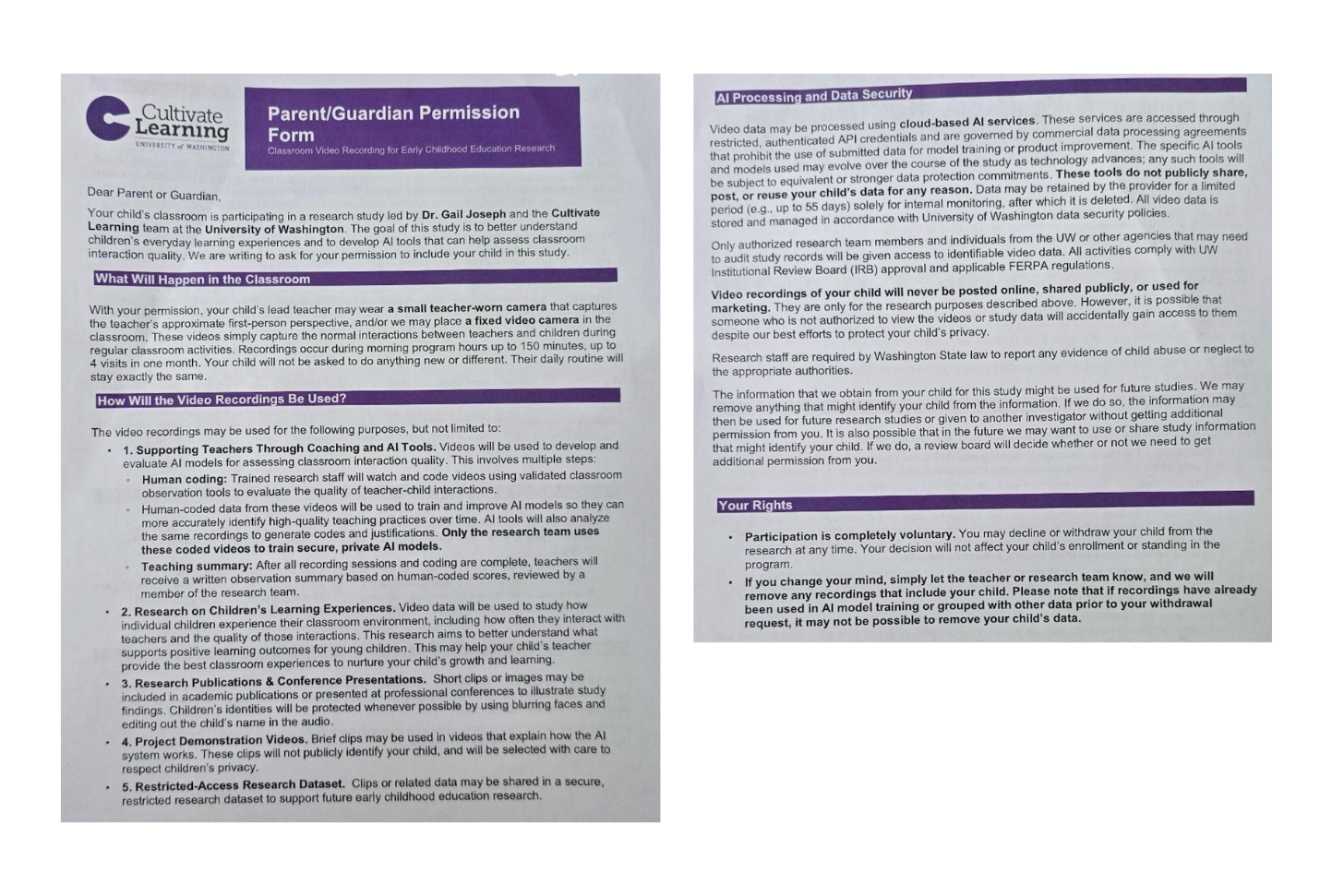
Image Credit: 404 Media
One parent who received the form told 404 Media she was "taken aback" after reading it. "I am troubled by the idea of using my child's likeness in unknown AI tools and how this could be abused," she said. "I was particularly concerned about families' ability to give informed consent. As a native English speaker, the vague language in the handout left me with a slew of questions. Many families in our school are migrants and non-native English speakers, but forms were not provided in any of their native languages."
Preschool programs, particularly those serving families on state childcare subsidy, often enroll children from immigrant families, non-English speaking households, and communities with complicated relationships to institutional authority. A form distributed only in English, using opt-out consent, in that environment, is not reaching everyone equally. Families who cannot navigate the form, or who fear institutional consequences for non-participation, are effectively enrolled without meaningful agreement.
What University of Washington Said
Jackson Holtz, assistant director of UW News, told 404 Media that if even a single family opted out, their entire classroom would be removed from the research. But parents only learned this through direct questioning of teachers and school administrators. The form itself does not explain this. The parent who spoke to 404 Media noted that even after learning about the opt-out mechanism, "no further information was provided on whether they would still be filmed."
Holtz described the outreach as "initial" and said it was "intended to help us better understand how families would feel about a project that uses artificial intelligence to support teachers." Using parents and children to test for whether an AI data collection program would be tolerated is its own kind of research.
After Cox contacted UW for comment, the study was terminated and removed from the Cultivate Learning website.
The IRB Problem
IRBs exist because researchers left to self-regulate have repeatedly prioritized scientific value over participant welfare. Milgram's obedience experiments deceived participants into believing they were delivering lethal electric shocks. The Tuskegee syphilis study ran for forty years on Black men who were never told they had syphilis and never offered treatment, even after penicillin became available. Tuskegee's exposure was the direct catalyst for the Belmont Report and, eventually, the Common Rule, codified at 45 CFR 46. It requires independent review of research involving human subjects and sets specific thresholds for when consent can be waived or altered. It establishes heightened protections for vulnerable populations, including children, under Subpart D.
The UW study should have triggered those heightened protections. Subpart D requires that research involving children present no greater than minimal risk, or offer the prospect of direct benefit to the child subjects themselves. AI model training on preschool video does not benefit the children filmed. The benefit flows to the model, to the researchers, and potentially to commercial partners downstream.
The opt-out consent structure is even harder to defend under the Common Rule. A waiver of standard informed consent is permissible only when all four conditions are met. The research must involve no more than minimal risk. The waiver must not adversely affect participants' rights and welfare. The research could not practicably be carried out without the waiver. And participants must be provided pertinent information after participation when appropriate.
This study fails at least two of those conditions clearly.
Minimal risk means the probability and magnitude of harm are not greater than those ordinarily encountered in daily life. Continuous first-person video of preschool children, processed by unspecified cloud AI services, used to train models with no defined commercial ceiling, is not a daily life encounter for a four-year-old. The form itself acknowledges that data retained by AI vendors for up to 55 days could be accessed by unauthorized parties "despite our best efforts." That is not a minimal risk disclosure, that is a liability hedge.
The "could not practicably be carried out without the waiver" condition is the weakest leg of any defense here. There is no reason AI training data collection on preschoolers requires opt-out consent. Opt-in would have reduced the sample size. That is a researcher convenience argument. IRBs are required to reject it.
So the question is not only whether the IRB approved this study, it is whether the IRB applied its own standards. If it granted a minimal risk determination and approved opt-out consent for a study involving AI model training on continuous video of minors from a population that includes non-English speaking immigrant families, that is a researcher failure and an IRB failure.
Image Credit: Schoolyard
The Funding Question
The form does not disclose who funded the research. Faith Boninger, co-director of the National Education Policy Center, flagged this directly when Cox shared sections of the document with her. "Who is funding the research?" she asked. She also noted that the language "not limited to" in the list of approved uses "implies that there could be any number of future uses to which the data may be put that haven't even been thought of yet."
Gail Joseph, PhD holds the title of Bezos Family Foundation Distinguished Professor in Early Learning at UW. Cultivate Learning was founded with support from the Bill & Melinda Gates Foundation. Both foundations have active AI and education technology interests and neither is mentioned in the document parents received that we know of. Funding shapes incentives, and when AI model development has clear commercial applications, parents deserved to know who had a stake in this.
The Withdrawal Fiction
The form tells parents participation is completely voluntary and they may withdraw at any time. Then it buries this:
Please note that if recordings have already been used in AI model training or grouped with other data prior to your withdrawal request, it may not be possible to remove your child's data.
You cannot un-train a model. The right to withdraw, offered prominently in the Your Rights section, is largely fictional once data has been ingested.
The opt-out process raised its own contradictions. UW told 404 Media that if even one family opted out, their entire classroom would be removed from the study. But parents learned through direct questioning of teachers and administrators that opted-out children would be marked with stickers. No one told them whether those children would still be filmed. If the whole class is removed when one family opts out, why are individual children being stickered at all? The form certainly didn't answer this.
The Larger Failure
UW terminated the study after the backlash. But this story is not primarily about UW. It is about what happens when AI data hunger meets institutions that control access to children, and the oversight infrastructure has not kept pace.
IRBs were designed to evaluate physical and psychological risk in clinical research. Most were not built to assess the long-tail harms of AI model training. What does it mean for a child's behavioral data to persist in a model indefinitely? What are the downstream risks of a classifier trained on preschool interaction patterns being commercialized, licensed, or repurposed? IRBs do not yet have standard frameworks for those questions. Most are still treating AI data collection the way they would treat a survey or an observation study. They are not the same thing.
The UW study is a case study in what happens when that gap goes unaddressed. A study involving continuous video surveillance of minors, cloud AI processing, undisclosed commercial potential, and opt-out consent in a vulnerable population appears to have moved toward deployment with, at most, a minimal risk determination. Either the IRB was not told the full picture, or it approved something it should not have, or the study proceeded without adequate review. All three possibilities are serious. None of them are unique to UW.
Academia needs to catch up. IRBs reviewing any study that involves AI data collection should be asking what happens to the data after the study ends, who can access it, whether the model trained on it can be commercialized, and whether a minimal risk determination is even coherent when the data subject is a child and the downstream use is undefined. Those are not speculative questions but they are the minimum standard for responsible review.
The Common Rule was revised in 2018, partly in response to the growth of data-driven research. HHS's own advisory committee acknowledged in 2022 that the result left AI research "compliant but not necessarily adequately protective." That gap is where this study lives.
I am continuing to report on this story. If you have information about the UW Cultivate Learning study, the IRB protocol, or similar research programs involving AI data collection in early childhood settings, you can reach me via email justplainkris@proton.me or at justplainkris.substack.com.
This post was written by me, with editing support from AI tools, because even writers appreciate a sidekick. This post originally appeared on www.kristinakroot.me.
References
Cox, J. (2026, May 18). Researchers Wanted Preschool Teachers to Wear Cameras to Train AI. 404 Media. https://www.404media.co/researchers-wanted-preschool-teachers-to-wear-cameras-to-train-ai/
Cultivate Learning University of Washington. (n.d.). Cultivate Learning. Retrieved May 21, 2026, from https://cultivatelearning.uw.edu/
Protections (OHRP), O. for H. R. (2022, July 25). Considerations for IRB Review of Research Involving Artificial Intelligence [Recommendation]. https://www.hhs.gov/ohrp/sachrp-committee/recommendations/attachment-e-july-25-2022-letter/index.html
Protections (OHRP), O. for H. R. (2021, March 12). Subpart D — Additional Protections for Children Involved as Subjects in Research [Page]. https://www.hhs.gov/ohrp/regulations-and-policy/regulations/45-cfr-46/common-rule-subpart-d/index.html