The Overlooked Cost of AI Infrastructure
Noise, Health, and the Communities Left Out
When we talk about the impact of AI data centers, the focus is typically on water use and electricity. But one impact that isn't being discussed nearly as much is noise. This week I came across two separate videos of people recording the constant noise coming from nearby data centers, one related to the AI data center near me in Vineland, NJ that I've talked about before, and one in Mississippi.
In Vineland, a resident living half a mile away from the Nebius and DataOne facility recorded the noise and shared it with Sustain NJ (Sustain SJ). The other person I came across lives about half a mile from the xAI data center in Southaven, MS, and he averaged 70-75 decibel levels outside and 55-60 decibel levels inside his home, and this occurs constantly, 24/7. He is part of the Safe and Sound Coalition, which is actively organizing to address the noise and broader impacts from the xAI facility.
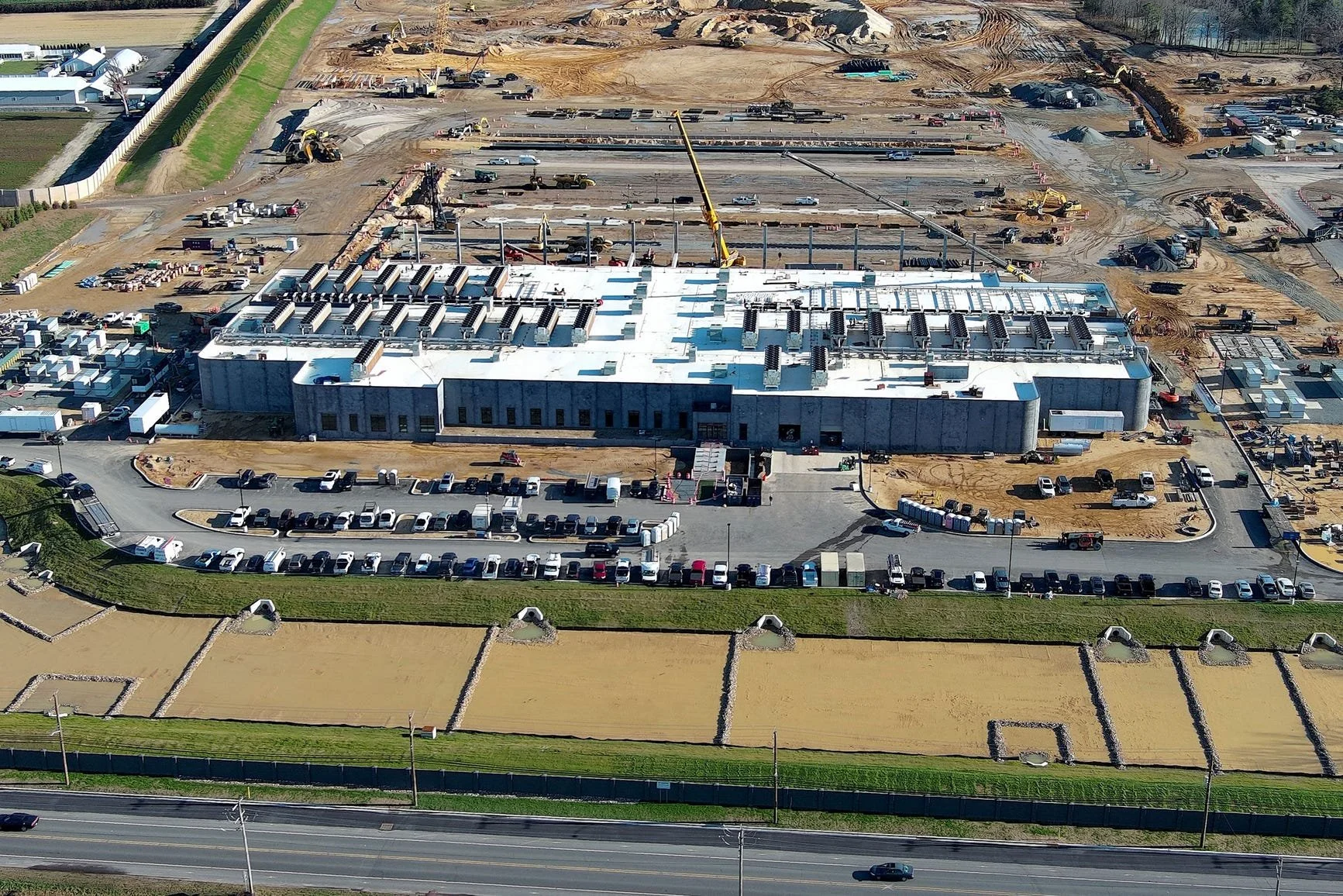
DataOne/Nebius Data Center, Vineland, NJ | Image Credit: www.app.com
To put that in context, the EPA identifies 55 decibels outdoors as the level that prevents activity interference and annoyance US EPA, the threshold below which normal activities like sleeping, conversation, and recreation are protected. The Southaven resident's outdoor levels are running 15-20 dB above that and nonstop.
In New Jersey specifically, state noise code N.J.A.C. 7:29 prohibits industrial and commercial facilities from producing continuous airborne sound exceeding 65 dBA at the property line of a neighboring commercial property, and no more than 50 dBA at a residential property line between 10 PM and 7 AM. These are legally enforceable standards, not guidelines. The DataOne Environmental Impact Statement itself acknowledges that operational noise from mechanical systems, cooling equipment, and primary and emergency backup generators is unavoidable, and that the facility will need to comply with these state noise regulations, yet the document offers no independent noise study, no baseline measurement from the surrounding residential area, and no demonstration that the facility will actually meet those limits in practice.
Chronic noise exposure at these levels has real consequences. Research shows that chronic noise exposure contributes to arterial hypertension and cardiovascular disease, with noise-induced sleep disruption identified as a key mechanism on the pathway from chronic noise exposure to adverse health effects (National Library of Medicine). Noise is considered the second largest environmental cause of health problems after air pollution, and has been associated with sleep disturbance, cardiovascular disease, and cognitive impairment (National Library of Medicine). The people living near these facilities are losing sleep and being exposed to a known, documented health stressor around the clock with no relief. For animals, both pets and wildlife, constant industrial noise interferes with communication, navigation, and stress regulation. Birds and other wildlife that rely on sound to find mates, detect predators, or migrate are especially vulnerable. This kind of noise doesn't just affect quality of life. It degrades the entire ecosystem around it.

Image Credit: DDS Acoustical Specialties
This is also why local politics matter more than most people realize.
Neither of these communities had meaningful say in what was built next to them. In Southaven, the xAI project was approved with no air permits, no independent health or environmental studies, and no public input, despite being surrounded by homes, churches, parks, and schools (Safe and Sound Coalition). In Vineland, the story is strikingly similar. The Nebius/DataOne facility sits across the street from and less than a quarter mile from residential homes. The project received its initial Planning Board approval in August 2024 and an amended approval in July 2025 before an Environmental Impact Statement (EIS) was prepared, meaning the project advanced through two rounds of major approvals without one (DataOne EIS, February 2026). The EIS that was eventually submitted acknowledges that some level of continuous operational noise is unavoidable, but provides no independent acoustic monitoring data and no noise modeling showing what residents adjacent to the site will actually experience. The project advanced through a redevelopment loophole that allowed officials to change zoning by ordinance rather than through a public process, with residents often told they are "too late" to object by the time they learn what's happening (Pinelands Preservation Alliance).
This pattern is playing out across the country. There are at least 142 activist groups across 24 states organizing around data center construction and expansion, with noise consistently cited alongside utility bills, water consumption, and property values as a core concern (Data Center Watch).
The Southaven residents have organized into the Safe and Sound Coalition, a grassroots group standing up for clean air, quiet nights, safe growth, and honest leadership, and are actively petitioning their local government. They are a good example of what community organizing looks like in practice and worth following.
So what can residents and communities actually do?
At the local level, file formal noise complaints with your municipality and request that officials conduct independent noise monitoring. Show up to planning and zoning board meetings when data center projects are being proposed or expanded, and demand that noise impact assessments be part of the approval process. That is where the real leverage is.
At the state level, check for state laws and push for noise ordinances that specifically address industrial and infrastructure facilities. In New Jersey, N.J.A.C. 7:29 already sets enforceable limits and residents can file complaints with their municipal health agency or the NJDEP, who will direct you to your county health department for certified noise enforcement. If the county determines noise levels exceed the legal limits, they can issue a formal violation that requires the facility to take corrective action, typically within 30 days, and demonstrate compliance. That violation also becomes an official record, which can be used to challenge future permits and flag compliance issues in any ongoing Planning Board proceedings. Penalties can accrue on a continuing basis for each day the facility remains out of compliance. Most existing ordinances in other states were written before this scale of infrastructure existed in residential-adjacent areas.
At the federal level, there is important history to know. In the 1970s, the EPA coordinated all federal noise control activities through its Office of Noise Abatement and Control. The office's funding was phased out in 1982 as part of a shift to transfer primary responsibility for noise regulation to state and local governments. The Noise Control Act of 1972 and the Quiet Communities Act of 1978 were never rescinded by Congress and remain in effect today, though essentially unfunded (US EPA). A House bill to restore funding, H.R. 4892, was introduced by Rep. Grace Meng and has been reintroduced in 2023 and 2025 (Providence Noise Project). Contacting your congressional representative to support that effort is a concrete action.
Communities can also organize and document everything. Recordings, acoustic analysis, and timestamped logs, like the kind residents near Vineland and Southaven are producing, create evidentiary records useful for regulatory complaints, local advocacy, and media attention. Connecting with neighbors and other affected communities strengthens that case considerably.
This post was written by me, with editing support from AI tools, because even writers appreciate a sidekick.
References
[@jhuser713]. (2026, March 8). xAI power plant noise [TikTok video]. TikTok. https://www.tiktok.com/@jhuser713
Data Center Watch. (2025, March). $64 billion of data center projects have been blocked or delayed amid local opposition.https://www.datacenterwatch.org/report
DataOne. (2026, February 24). DataOne Sustainable Datacenter Environmental Impact Statement Vineland, NJ Facility. https://www.kristinakroot.me/s/DataOne-EIS224_redact.pdf
Münzel, T., Gori, T., Babisch, W., & Basner, M. (2014, April 1). Cardiovascular effects of environmental noise exposure. European Heart Journal, 35(13), 829–836. https://doi.org/10.1093/eurheartj/ehu030
Pinelands Alliance. (2026, February 26). Data centers invading NJ through redevelopment loophole. https://pinelandsalliance.org/data-centers-invading-nj-through-redevelopment-loophole/
Providence Noise Project. (n.d.). Federal Noise Law. https://providencenoiseproject.org/laws/federal-law/
Roscoe, C., Grady, S. T., Hart, J. E., Iyer, H. S., Manson, J. E., Rexrode, K. M., Rimm, E. B., Laden, F., & James, P. (2023, December 3). Association between Noise and Cardiovascular Disease in a Nationwide U.S. Prospective Cohort Study of Women Followed from 1988 to 2018. Environmental health perspectives, 131(12), 127005. https://doi.org/10.1289/EHP12906
Safe and Sound Coalition. (n.d.). Safe and Sound Coalition (Southaven and surrounding communities). https://safeandsound.info
Sustain SJ. [@sustain_sj]. (2026, March 9). Noise half mile away from DataOne's data center in Vineland, NJ [Instagram video]. https://www.instagram.com/reel/DVqig4NgJyE/?utm_source=ig_web_copy_link&igsh=MzRlODBiNWFlZA==
U.S. Environmental Protection Agency. (2025, November 6). EPA History: Noise and the Noise Control Act. https://www.epa.gov/history/epa-history-noise-and-noise-control-act
U.S. Environmental Protection Agency. (1974, April 2). EPA identifies noise levels affecting health and welfare [Press Release]. https://www.epa.gov/archive/epa/aboutepa/epa-identifies-noise-levels-affecting-health-and-welfare.html