When a Data Center Claims It Can Talk
Inside the Monroe Township, NJ Lawsuit
Being a south New Jersey resident, I've been following the AI data center development in New Jersey and eastern Pennsylvania closely. For those who may not be familiar with south Jersey, various parts of it tend to be more rural, thanks to the amount of farmland here. I've written before about the DataOne/Nebius data center in Vineland and how it's affecting nearby residents (read here). I've also been following what's happening in Monroe Township, Gloucester County closely, after the township banned data centers in April 2026, following Hexa Builders' proposal to convert part of a warehouse project into a data center. Monroe banned them after listening to residents who packed township meetings to voice concerns about high electricity demand, water use, and 24/7 operations near homes. Some residents pointed to what happened in Vineland with DataOne as exactly what they didn't want in their own backyard.
Sites like this get described as rural, and they are, farmland, wooded buffers, and plenty of open space. But rural doesn't mean empty. Residential neighborhoods still sit close enough to hear the noise, feel the impacts on water quality and electricity rates, and see the light pollution once construction starts.
This case is worth watching closely. Every other data center lawsuit I could find, in North Carolina, Kentucky, Texas, Virginia, argues procedure or vested rights. As far as I can tell, this is the first one anywhere to argue free speech and equal protection together. Nobody's tried this exact combination before.
I'm spending most of this piece on the free speech and equal protection claims because they're the ones nobody's tested before, not because they're Hexa's best shot. The stronger argument, procedurally, is probably one buried in count six, which I'll get to that. But the free speech theory is the one that would actually change something beyond this one lawsuit if it won, so that's where I want to spend the most time.
I pulled the actual court filing and Hexa brings 20 separate counts, each attacking one of three government actions: the 2026 Redevelopment Plan Banning Data Centers on the Property, the Ordinance Banning Data Centers Town-Wide, and the Planning Board's "incompleteness" determination on Hexa's application. Nearly every count seeks the same thing, damages in excess of $300,000,000, plus attorney's fees, plus a declaration that the relevant ordinance is void. For scale, the application itself was for a 522,000 square foot warehouse and a separate 1 million square foot data center, roughly 1.6 million square feet combined across the two buildings.
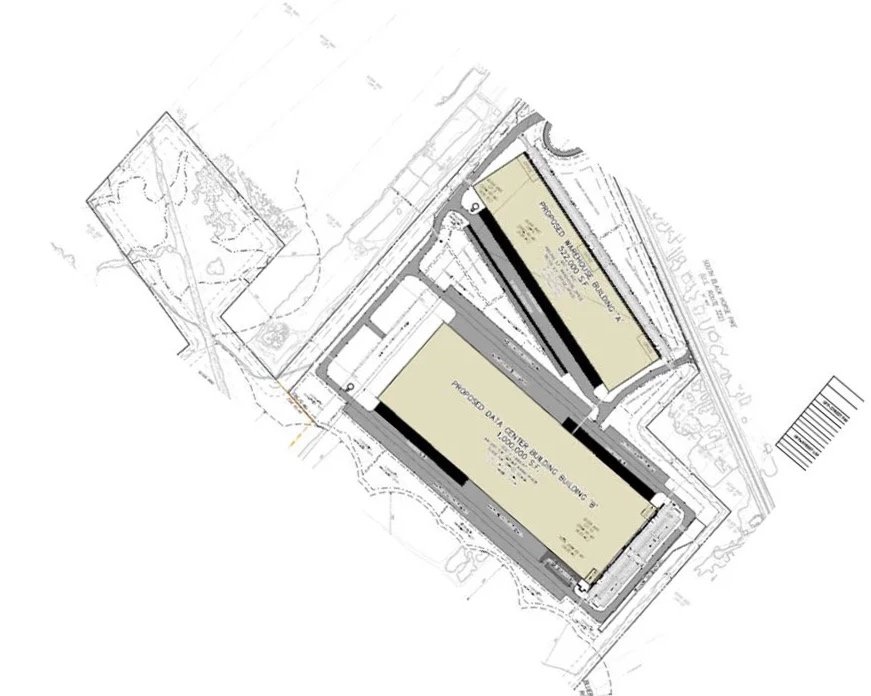
Hexa Builders Monroe Township Data Center Plan
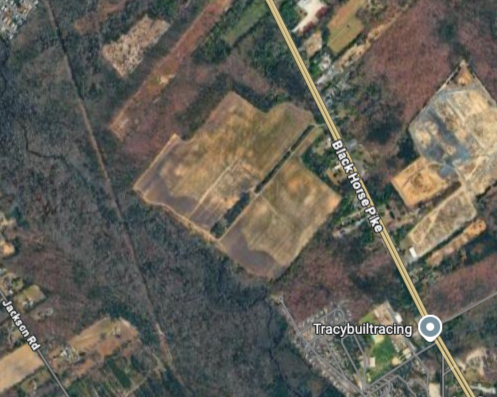
Monroe Township Map View
The Free Speech Argument, and What Happens if Hexa Wins It
Count four argues data centers count as a medium of communication. Same category as billboards. Same category as satellite dishes. So not a new legal idea, just a new place to apply it.
Billboards say something. Satellite dishes carry a broadcast meant for someone. A data center processes information it didn't write and that isn't addressed to anyone in particular. That's a stretch from the cases Hexa is leaning on. Not a crazy one, though. Back in 2011, the Supreme Court ruled in Sorrell v. IMS Health that the creation and dissemination of information are speech for First Amendment purposes. That case was about pharmacy data, not buildings. Even the dissent saw this coming. Justice Breyer warned the ruling could open a Pandora's Box of First Amendment challenges to many ordinary regulatory practices that only incidentally touch speech. That warning from 2011 is basically describing what's happening in Monroe right now. Hexa didn't cite Sorrell, interesting given how closely it maps onto their argument. If this theory ever gets tested on appeal, I'd expect someone to reach for it.
Hexa's lawyers are not inventing this category from nothing. No court has ever decided which category a data center falls into, but the operating principle is well established. Courts have found phone companies become First Amendment speakers when they curate content, bundling TV programming, for instance, and stay unprotected common carriers when they just transmit whatever comes through indiscriminately. It's not about the industry. It's about the function. A data center processing whatever a tenant sends it, without picking or arranging any of it, looks like the unprotected function, not the protected one. That's a reasoned prediction about where a court would likely land if forced to decide, not a settled answer, since nobody's drawn that line for data centers yet.
Whose speech is this, really? Hexa is a developer, it's not running the data center, storing data, or sending communications through it. No tenant has been named for the property, and hyperscale data centers this size are typically leased to an operator rather than run by the developer itself. So the actual question is whether a landlord gets to claim First Amendment rights on behalf of speech some future, unnamed tenant might someday engage in. That's a real question, and one Hexa's own theory doesn't fully answer yet.
So What Happens if a Court Sides with Hexa
Right now, towns get an easy pass on zoning. Courts figure a town probably had a decent reason and move on. If a court decides banning data centers is a speech restriction, that pass disappears. Monroe would have to prove it had a real reason, and that it tried the least aggressive option first. A full ban doesn't clear that bar as easily as "yes, we had concerns."
The federal government's own stance matters here too. The Trump DOJ and EPA have already stepped into a separate data center case in Mississippi, on the side of the operator, arguing the facility's importance to AI expansion and innovation, national energy infrastructure, and national and economic security outweighs a citizen environmental suit. Federal actors are already treating data centers as a protected national priority. That's the backdrop any court weighing this theory would be deciding against, and it makes it harder, not easier, for a town to say no.
If we look at it further, Maine already passed the country's first outright data center construction ban. New York's legislature passed a one year construction pause in June. Georgia introduced a bill barring new data center permits until 2027, though it's currently stalled in committee. Oklahoma is weighing its own multi year pause. None of these states are bound by what happens in Gloucester County, this is one township's ordinance, working through one federal district court. But if Hexa's free speech theory wins anywhere, every developer fighting one of those bans has a ready made argument by Monday morning.
This is what actually bothers me about it, though. If moving data around counts as protected expression, that logic doesn't stop at data centers. It's a short walk from "this building is speech" to "any company that touches data has speech rights a town can barely regulate." Residents who showed up to Monroe's meetings were doing the thing the First Amendment was built to protect, speaking, organizing, telling their government what they wanted. A win for Hexa would mean the machines processing someone else's messages get treated like they're doing the same thing.
The 14th Amendment Argument
This one runs on a different engine, and a simpler one. Equal Protection doesn't require the same intense justification as free speech. It just asks whether the town had any rational reason for treating similar things differently. Hexa's argument: Monroe allowed other similar uses including warehouses and other high water use facilities to move forward, but singled out data centers specifically and banned just that one. Their claim is there's no real reason for the different treatment. That's the whole theory, repeated three times, once for each of the three government actions listed above.
This is also why I think it's the weaker of the two claims, even though it sounds like the more grounded one. Courts are deferential to zoning decisions almost by default. Monroe just has to point to noise, water use, or power draw as its stated reason, and that will likely be enough to survive.
There's something to note though. According to the complaint, the mayor said at a March 2026 council meeting that the township would do "everything in our power to stop all data centers from coming here," before any of the noise or water justifications were formally on the record. If that's accurate, Monroe isn't just defending a rational policy choice anymore. It's defending a decision that may have come first, with the justification built afterward. That doesn't automatically sink the town's position. Courts still tend to accept a legitimate reason even if it shows up late. But it does mean this claim isn't quite the easy pass I made it sound like a minute ago.
Put the two side by side and the shape of this case comes into focus. Equal Protection asks for a reason. Free speech asks for a reason, plus proof that nothing narrower would have worked. Monroe's real fight isn't over whether it had grounds to act, it's over whether an outright ban was the only tool it had.
The Count that Actually Worries Me More than Free Speech
Reporters covering this case have focused almost entirely on the free speech and equal protection claims. Count six barely gets a mention, failure to comply with municipal ordinances in determining completeness. Two weeks before Monroe's town-wide ban passed, the Planning Board didn't reject Hexa's application, it called it incomplete. That distinction matters more than it sounds like it should. New Jersey has a rule called the time of application doctrine. A developer's rights can lock in based on whatever zoning was in effect the day they filed a complete application, not whatever zoning shows up later. Calling an application incomplete, right before a ban takes effect, is one way a town could sidestep that rule instead of following it. If a court decides that's what happened here, Hexa doesn't need the free speech theory to hold, and it doesn't need to win on equal protection either. It just needs to show the incompleteness finding was a pretext. That's a much narrower, much more provable claim than "data centers are speech," and it's the one I'd actually bet on if I had to pick just one.
What Monroe Will Likely Argue Back
None of this happens in a vacuum. Monroe's expected defense, once it answers the complaint, is straightforward. Zoning is a core municipal power, and courts have deferred to it since Euclid v. Ambler in 1926. The township will likely argue its stated interests, grid strain, water use, noise, are exactly the kind of substantial and well documented reasons the law requires, and that a full ban, adopted after months of public hearings, wasn't reaching for the most extreme option so much as responding proportionately to a genuine local capacity problem.
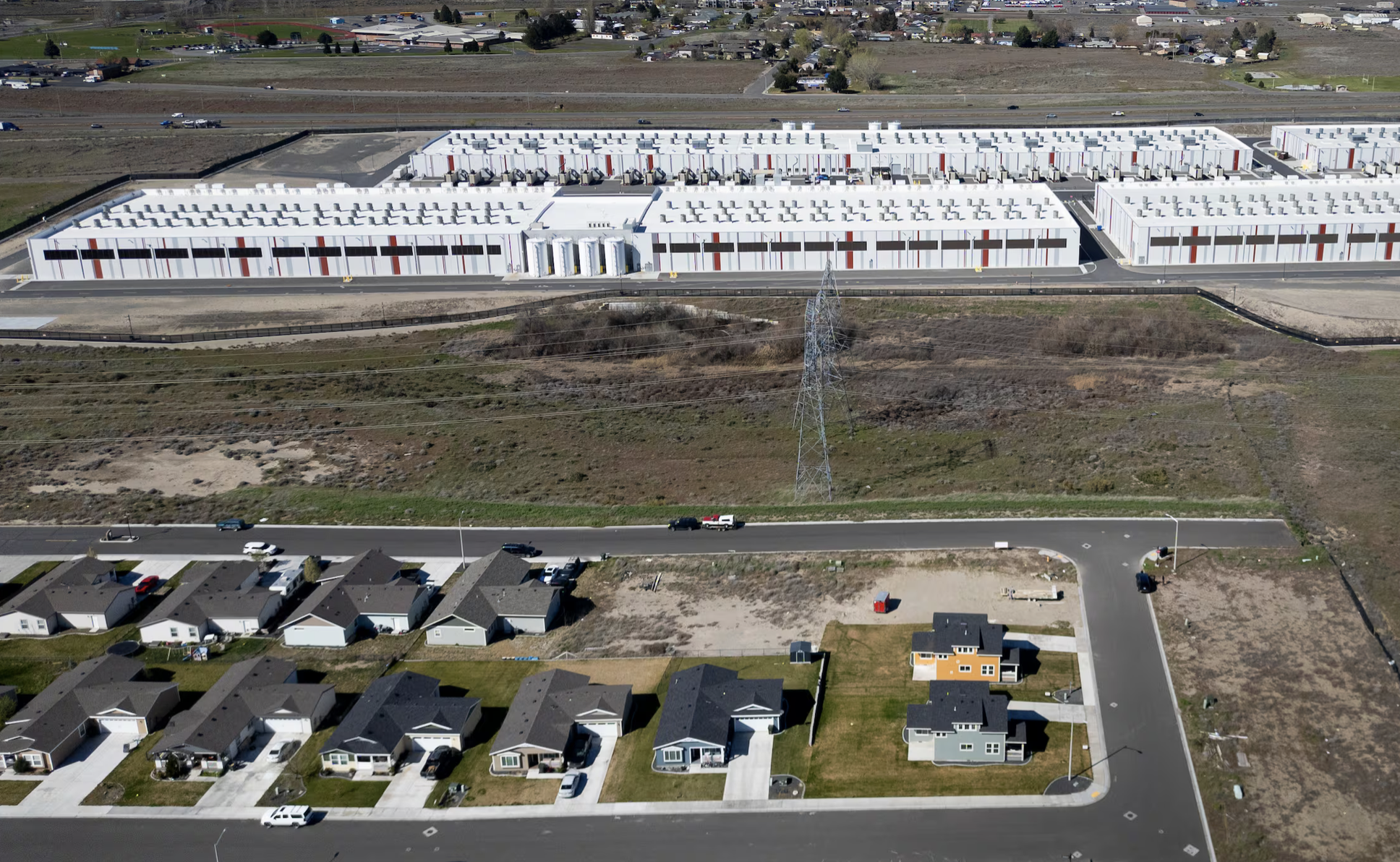
Amazon Data Center, Umatilla, Ore.
Photo Credit: Saskia Hatvany
Where this Leaves Things
Corporations having speech rights isn't actually the open question here. That fight ended with Citizens United, whatever anyone thinks of it. The real question is narrower, and harder to wave away. Does something count as speaking if it never chose what to say, never curated anything, and just moves information other people already produced? Residents who showed up to Monroe's meetings were doing what the First Amendment was built to protect, speaking for themselves, to their own government, about their own town. A win for Hexa wouldn't hand speech rights to a corporation, corporations already have those. It would hand them to a building that has never said anything at all.
References
Hexa Builders, LLC & 3043 Williamstown Urban Renewal, LLC v. Mayor & Township Council of Monroe & Planning Board of the Township of Monroe, No. GLO-L-000805-26 (N.J. Super. Ct. Law Div. complaint filed June 5, 2026).
Marshall, N. (2026, May 15). This N.J. town banned AI data centers — and then rejected a huge project to prove it. NJ.com via Yahoo News. https://www.yahoo.com/news/articles/n-j-town-banned-ai-100138072.html
Nicell, S. (2026, July 17). A real estate developer has sued a South Jersey township for $300 million over its data center ban. The Philadelphia Inquirer. https://www.inquirer.com/south-jersey/monroe-new-jersey-data-center-ban-lawsuit-20260717.html
Russell, J. (2026, June 9). Hexa Builders sues Monroe Township over data center ban, seeks more than $300 million in damages. The Woodbury Warbler. https://woodburywarbler.com/hexa-builders-sues-monroe-township-over-data-center-ban-seeks-more-than-300-million-in-damages/
Sorrell v. IMS Health Inc., 564 U.S. 552 (2011). Justia U.S. Supreme Court Center. https://supreme.justia.com/cases/federal/us/564/552
Velamoor, S., Geltzer, J. A., Beaudreau, T. P., Dunbar, K. P., Soiffer, A., Holtzblatt, A., Kamelgard, B., & Brashear, C. A. (2026, July 13). Data centers in court: The emerging wave of nuisance, environmental, and land-use litigation.WilmerHale. https://www.wilmerhale.com/en/insights/client-alerts/20260713-data-centers-in-court-the-emerging-wave-of-nuisance-environmental-and-land-use-litigation
Vile, J. R. (2009). Sorrell v. IMS Health (2011). The First Amendment Encyclopedia, Middle Tennessee State University. https://firstamendment.mtsu.edu/article/sorrell-v-ims-health/